
USDC to USDT Swap Exploited with a $215k Loss, How Does MEV Attack Stablecoin Trades?




Original Article Title: Crypto trader gets sandwich attacked in stablecoin swap, loses $215K
Original Article Author: Brayden Lindrea, Cointelegraph Author
Original Article Translation: ChatGPT
Editor's Note: This article covers a sandwich attack incident that occurred in a cryptocurrency trade, where a trader lost over $215,000 during a stablecoin exchange. The article provides a detailed account of the attack, including how MEV bots profited through frontrunning and discusses potential money laundering activities. Additionally, it mentions the protective measures taken by the Uniswap platform to prevent such attacks and clarifies initial criticisms.
Below is the original content (slightly rephrased for better readability):
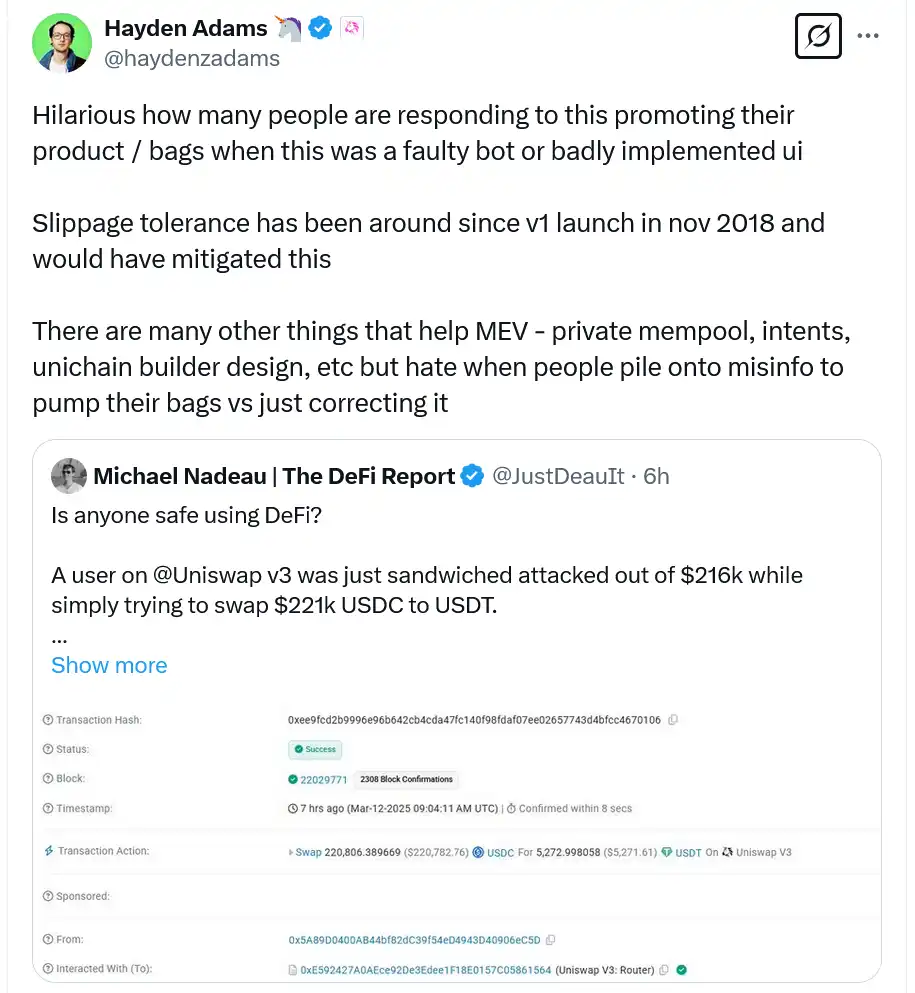
On March 12, a crypto trader fell victim to a sandwich attack while transferring $220,764 in stablecoins, losing nearly 98% of its value, amounting to $215,000, which was captured by a MEV bot.
A $220,764 USDC stablecoin value was swapped to $5,271 Tether USDT within 8 seconds, as the MEV bot successfully front-ran the transaction, profiting over $215,500 from it.
Data from the Ethereum block explorer shows that this MEV attack occurred in the USDC-USDT liquidity pool of the decentralized exchange Uniswap v3, with assets worth $19.8 million locked in the pool.
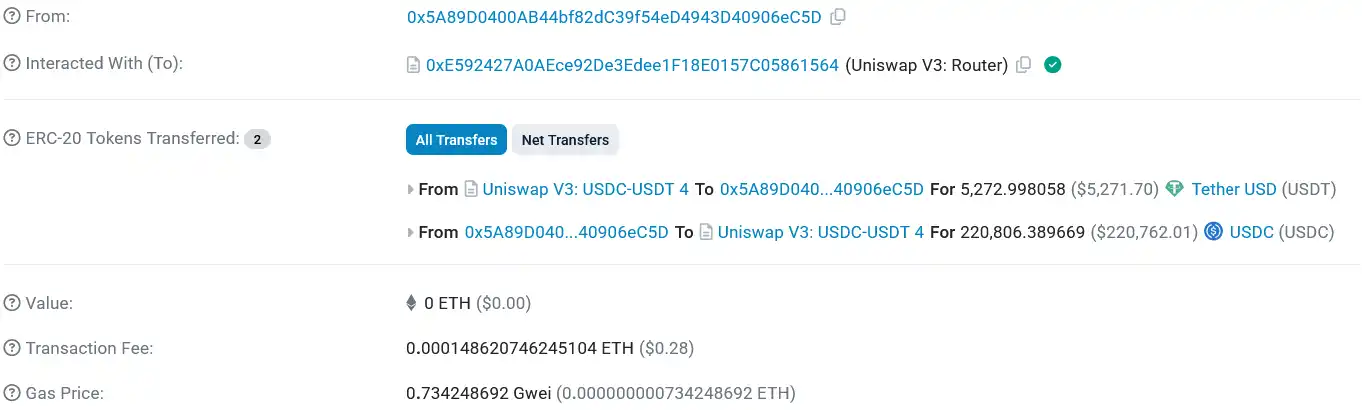
Details of the Sandwich Attack Transaction Source: Etherscan
According to Michael Nadeau, the founder of The DeFi Report, the MEV bot front-ran by swapping out all USDC liquidity from Uniswap v3's USDC-USDT pool and then putting it back after the transaction execution.
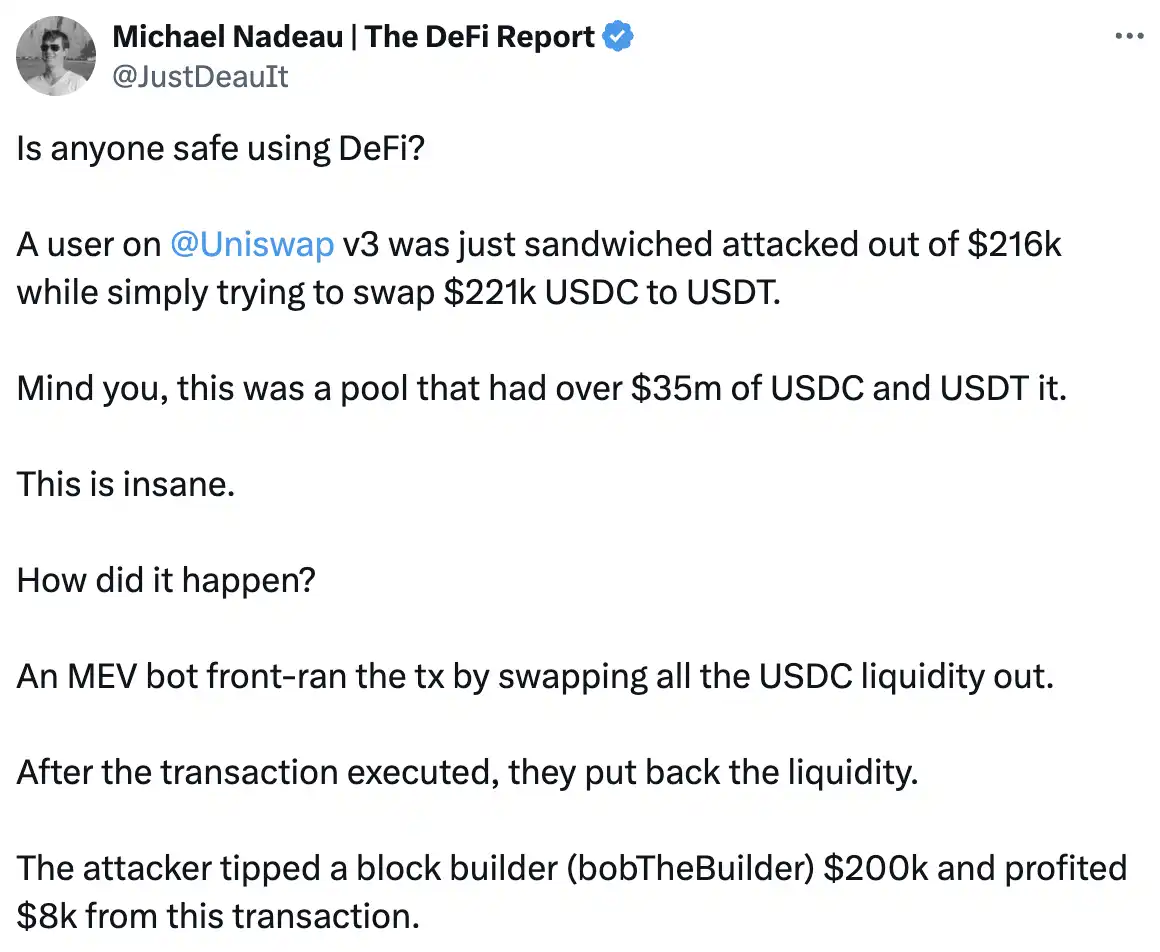
Nadeau stated that the attacker paid a $200,000 fee to the Ethereum block builder "bob-the-builder.eth" from the $220,764 transaction and pocketed $8,000 for themselves.
DeFi researcher "DeFiac" speculated that the same trader using different wallets may have experienced a total of six sandwich attacks, citing "internal tools" as evidence. They noted that all funds were sourced from the Aave lending protocol before being deposited into Uniswap.
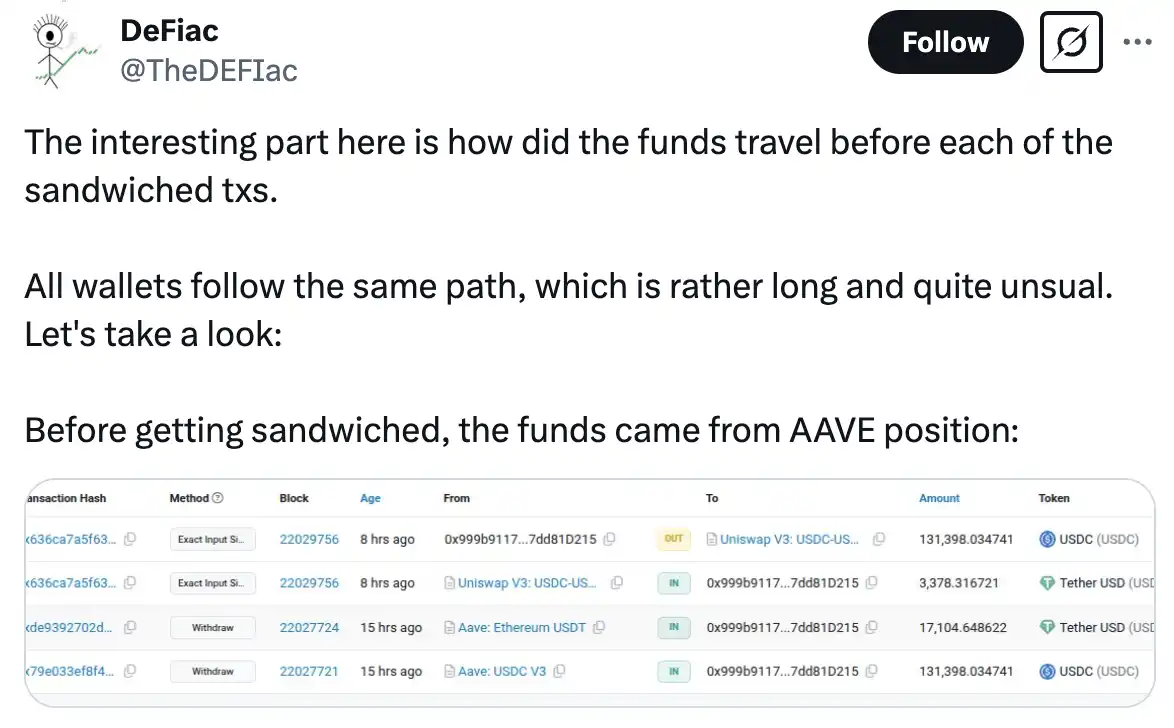
Two wallets fell victim to MEV sandwich attacks around 9 a.m. UTC on March 12th. Ethereum wallet addresses "0xDDe…42a6D" and "0x999…1D215" were sandwich attacked in transactions that occurred three to four minutes apart, resulting in losses of $138,838 and $128,003, respectively.
These two traders conducted trades in the Uniswap v3 liquidity pool similar to a trader exchanging $220,762.
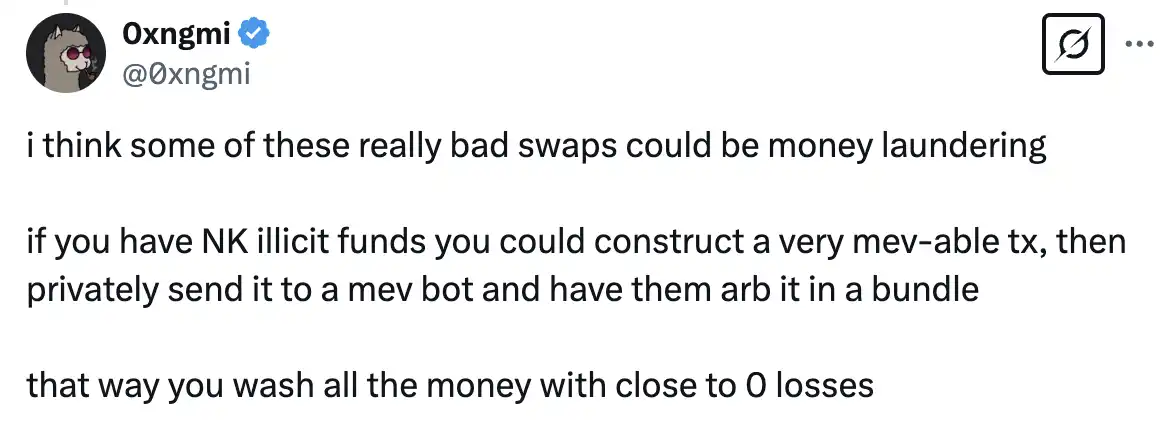
Speculation arose that these transactions might be related to money laundering.
0xngmi, the founder of the crypto data dashboard DefiLlama, stated, "If you have NK illicit funds, you can construct a transaction that is very easily exploited by MEV and privately send it to an MEV bot, allowing them to arbitrage in a bundle. This way, you can wash all the money with close to zero loss."
While Nadeau initially criticized Uniswap, he later acknowledged that these transactions did not originate from Uniswap's frontend, which has MEV protection and default slippage settings.
After Uniswap CEO Hayden Adams and others clarified the protective measures taken by Uniswap to prevent sandwich attacks, Nadeau retracted those criticisms.
You may also like

On-chain finance: On-chain IPOs and on-chain ICOs, a new frontier in the trillion-dollar market

Rented Belief: How Much of the Bitcoin ETF Fund Flow is Real Money

The two giants are racing in "credit": loan balances of 9.9 billion vs 14.6 billion USD, Brazil has become the main battlefield

A company that was on the verge of bankruptcy has just surpassed Bitcoin in market value

B.AI partners with MiniMax to launch a limited-time free experience of M3, enabling zero-threshold implementation of Agentic productivity through full-stack infrastructure

The second half of the computing power battle: Intel CEO Pat Gelsinger reveals how AI is reshaping the global semiconductor supply chain

WEEX Live mode: Monitor 20 trading pairs at once and trade like a pro

Morning Report | Secret Network loses $4.67 million due to cross-chain vulnerability; Michael Saylor releases Bitcoin Tracker information again, may disclose increased holdings data next week

Kalshi's biggest competitor is not Polymarket
WEEX Makes Affiliate Access Easier on the Web and in the App
Customize Your Spot Trading Page: Drag Modules and Move the Order Panel Where You Want It

Perp DEX: The Next Generation Exchange "War"

10 Counterintuitive Insights on Latin American Payments

The AI gamble of mining companies: Valuations enter a phase of differentiation, and it's hard to turn the tide
A letter from Alliance to entrepreneurs: Written on the occasion of Cursor selling for 60 billion dollars
Stablecoins Finally Find Real Returns: On-Chain Reinsurance Re Explained | Interview with Re Founder Karan Saroya

The impossible triangle is simply a pseudo problem

Will MicroStrategy fall into a death spiral? What will the macro trend be in the second half of the year?
On-chain finance: On-chain IPOs and on-chain ICOs, a new frontier in the trillion-dollar market
Rented Belief: How Much of the Bitcoin ETF Fund Flow is Real Money
The two giants are racing in "credit": loan balances of 9.9 billion vs 14.6 billion USD, Brazil has become the main battlefield
A company that was on the verge of bankruptcy has just surpassed Bitcoin in market value
B.AI partners with MiniMax to launch a limited-time free experience of M3, enabling zero-threshold implementation of Agentic productivity through full-stack infrastructure
The second half of the computing power battle: Intel CEO Pat Gelsinger reveals how AI is reshaping the global semiconductor supply chain


