
Crypto.Com witnessed a Ridiculous Governance Farce, as an Entity with 70% Voting Power Forced a 700 Billion CRO Coin Mint


Original Article Title: "Crypto.com Unfolds Absurd Governance Drama, Holding 70% Voting Power to Force 700 Billion CRO Mints"
Original Article Author: Symbol; Paper Box Ninja
Editor's Note: Several weeks ago, Crypto.com proposed a plan to reissue 700 billion burned CRO tokens. During the two-week voting period, the turnout fell short of the required threshold. If there wasn't enough participation by the deadline, the proposal would be scrapped. However, the day before the deadline, a sudden influx of 33 billion CRO token holders joined the vote, overwhelmingly pushing the proposal through. These sudden voters were none other than Crypto.com itself.
On Sunday, what seemed to be a potentially failing proposal—aimed at minting 700 billion CRO to offset the 2021 burn of an equivalent amount of tokens and reintroduce them to the market—struggled with a slim majority of affirmative votes over dissenting votes for most of the voting period (March 2 to 16) and failed to meet the required statutory quorum of 33.4%.
However, a dramatic turn of events unfolded at 14:00 UTC on Sunday, suddenly adding 33.5 billion CRO tokens to the affirmative votes, meeting the required votes for the proposal to pass by a significant margin. The final vote breakdown showed: 61.18% in favor, 17.61% against, 20.11% abstain, and 0.11% veto; with an overall turnout rate of 70.18%, far exceeding the minimum threshold of 33.4%.
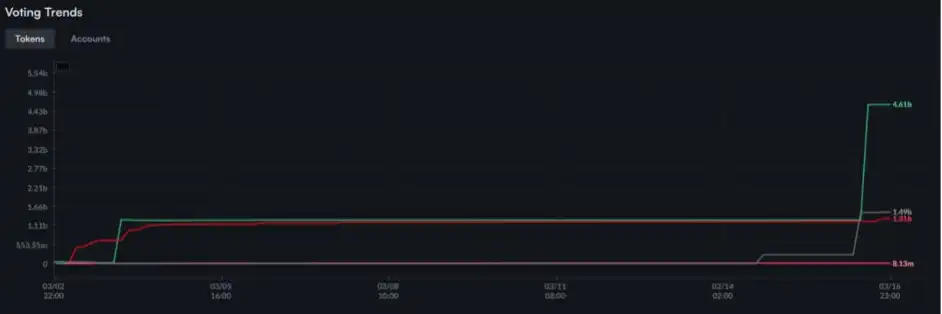
The last-minute surge in votes ultimately led to the proposal's passage. Source: Mintscan
The sudden surge in votes has left many disgruntled CRO holders feeling even more aggrieved, with them viewing it as a further betrayal of trust between Crypto.com and its holders. "Very disappointed," remarked one CRO whale on Telegram, "they almost all voted at the last minute, setting a malicious precedent that could be emulated by other projects."
The crux of this controversy lies in the bulk of the votes coming from large validators operated by Crypto.com. Three independent sources indicate that these validators control between 70% to 80% of the total voting power. As of March 10, only two of its validators—Starship and Falcon Heavy—voted in favor. Despite the affirmative vote accounting for only 11.86%, far below the 77.97% opposition vote and 8.47% abstain, it did not prevent the proposal from being approved.
A representative from Crypto.com also declined to comment on this.
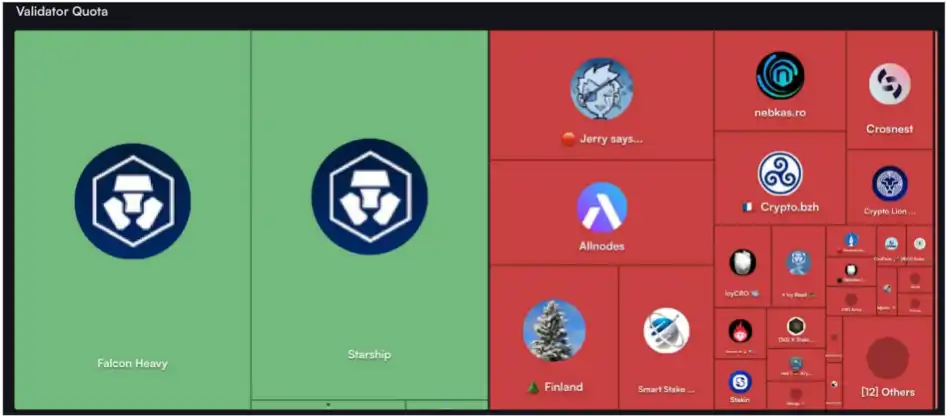
As of the March 10 voting results, data source: Mintscan
As the vote neared its end, three other validators controlled by Crypto.com—Electron, Antares, and Minotaur IV—also joined the yes camp; in addition, two smaller independent validators, Cosmostation and Polkachu.com, expressed their support, although their votes had little impact on the final result.
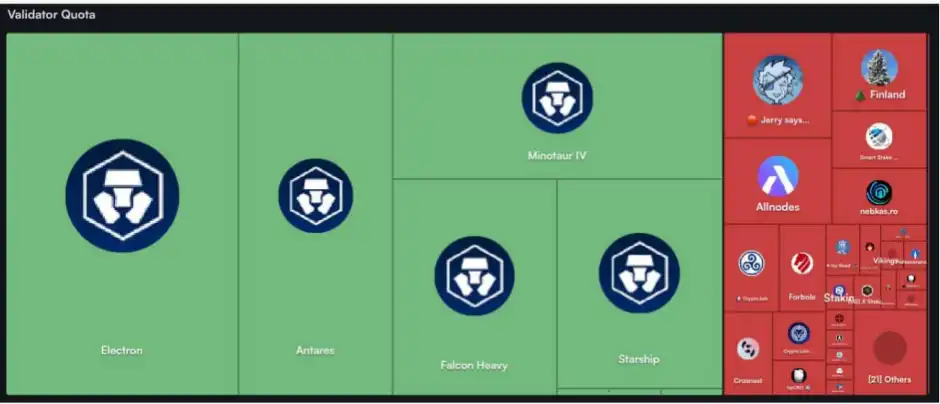
Final voting result, data source: Mintscan
With the proposal approved, the Cronos blockchain will undergo an upgrade tomorrow, during which 700 billion new tokens will be minted, while the 700 billion tokens burned in 2021 will remain out of circulation. These new tokens will be gradually released according to a five-year vesting plan and will undertake various functions, including initiating a potential CRO ETF.
However, the actions of the Crypto.com team did not stop there. On the day after the end of the vote, the team launched another proposal to burn 50 million CRO tokens (equivalent to 0.07% of the newly minted tokens) to supplement the previous three burns of the same amount. A CRO validator who voted against the re-minting proposal on Telegram indignantly wrote, "This is simply an insult to all CRO holders. How dare you propose to burn 50 million tokens on the same day you are reminting 700 billion tokens?"
The vote on this new proposal will continue for the next two weeks.
This article is a contributed piece and does not represent the views of BlockBeats.
You may also like

Morning Report | CoinEx becomes a key hub for Iran to evade sanctions, involving over $3.8 billion in funds; Kalshi seeks a new round of financing, with a valuation potentially rising to $40 billion

Why do cryptocurrency projects always like to change their names?

From the white-haired stock god to the billionaire fund mogul, the smart people shorting Nvidia are all getting rich using the same framework

Morning News | The draft amendment to the People's Bank of China Law aims to clarify the legal status of digital renminbi; South Korea will transfer about 40 unregistered virtual asset service providers to law enforcement agencies

The cryptocurrency industry has entered the "Show Me" era: merely relying on vision is no longer enough
Interpreting the Ethereum Foundation's new structure: Reaffirming self-sovereignty amid institutional trends
Former SpaceX engineer reconstructs the financial execution system using first principles

Tidal Investment: We still have a positive outlook on the AI industry chain, but the reasons have changed

Standard Chartered Bank sings a 50x rhapsody again, aiming for AAVE to reach 3500 USD

The interim executive director of the Ethereum Foundation speaks out: What is our mission?
Why does OKX want to start a new company with the parent company of the New York Stock Exchange?

Why Is PAXG Price Different From Gold? 5 Reasons Crypto Traders Should Know

WEEX OpenAPI 101: 5 Powerful Modules, AI Trading Tools, and Grab Up to 70% Revenue Opportunities
Learn how WEEX OpenAPI connects traders, developers, AI agents, and trading platforms. Discover WEEX API features, Binance-compatible integration, automated trading workflows, revenue opportunities, and ecosystem possibilities.

Interview with NDV Founder Jason Huang: Popping the AI Bubble and the Myth of Microstrategy, Seeking the Ultimate Ace in the Crypto Market

Morning Report | Former Ethereum Foundation researcher establishes Ethlabs; EU Parliament Economic Committee passes digital euro regulatory proposal

Dragonfly partner Haseeb: The fastest-growing companies in the future may all be stuck at 149 people

How xBubble Breaks the Deadlock in VC's Heavy Investment in the OPC Economy

The encrypted unicorn Blockstream is deeply embroiled in a serious fraud case
Morning Report | CoinEx becomes a key hub for Iran to evade sanctions, involving over $3.8 billion in funds; Kalshi seeks a new round of financing, with a valuation potentially rising to $40 billion
Why do cryptocurrency projects always like to change their names?
From the white-haired stock god to the billionaire fund mogul, the smart people shorting Nvidia are all getting rich using the same framework
Morning News | The draft amendment to the People's Bank of China Law aims to clarify the legal status of digital renminbi; South Korea will transfer about 40 unregistered virtual asset service providers to law enforcement agencies
The cryptocurrency industry has entered the "Show Me" era: merely relying on vision is no longer enough
Interpreting the Ethereum Foundation's new structure: Reaffirming self-sovereignty amid institutional trends


